Posts

New Zealand - Kai Iwi Lakes, Kauris, and Goodbyes

Image
Our last week in New Zealand was a house sit in the middle of a dairy farm about 20 kilometers (12 miles) outside of Dargaville in the Northland section of the North Island. We had nothing to do with the dairy itself, but we looked after the house and pets of the dairy’s owners. The pets included Frankie, a female dog who was kept outside (which killed Deborah), and Diddy, a male gray cat the owners described as “a bit nutty.”   Somehow Frankie’s bed made its way just inside the sliding glass door and received a comfy new cover that Deborah sewed together out of bath towels. Thus was reached a compromise between or desire to have the dog join us in the house and the owner’s desire to keep her outside. Diddy the cat got his wet food in the morning and all the crunchies he wanted the rest of the day. But if he wanted more wet food (which was always) he would let out his high-pitched cry if you were in the kitchen anywhere near his bowl, and swat at your legs if you were foolish eno...
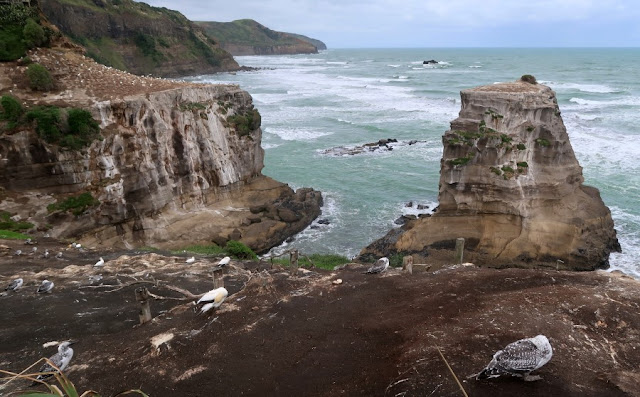
New Zealand - Muriwai Beach Gannet Colony

Image
Muriwai Beach is not far west of Auckland and is home to a breeding colony of gannets. These birds were fun to watch as the adults flew back and forth between the feeding grounds out to sea and their   still flightless offspring at the cliffside nesting sites. The juveniles tap the beaks of the returning parents as they beg for a fishy regurgitated meal. Yum. Muriwai Beach Gannet Colony The white ones are the adults; the gray ones the juveniles. Adult Gannet Each little mound is a nesting site. Once the chicks have grown they fly off to Australia, usually by May. Since many mounds were unoccupied and the existing offspring were nearly as big as their parents when we visited in mid-March, I suspect that many have already flown off. Juvenile Gannet This juvenile was testing its wings, though it never did take off. But you could tell it was thinking about it. Video: a gr...

New Zealand - Hamurana Springs

Image
Hamurana Springs is the deepest natural fresh water spring in the North Island. It pumps out 4.5 million liters (1.2 million gallons) per hour and feeds a crystal clear stream that drains into Lake Rotorua. We walked the loop trail through the nature reserve that contains the springs and stream, and at one point came upon the unexpected sight of a grove of coastal redwoods. We later learned that these were planted in 1919, most likely by the farmer on the site at the time. The tallest of these trees are now an impressive 55 meters (180 feet). Add to that tree ferns, ducks, trout, swans and incredibly clear waters and you have a very special place. Redwoods at Hamurana Springs. It only looks like California. (photo by Deborah) Black Swans, having just lifted their heads after feeding underwater. They're really not drooling. Duck video, including a very brief chase scene.

New Zealand - Rotorua

Image
Rotorua is known as a center for Maori culture which we unfortunately didn’t manage to find time for. But it is also as the heart of a geothermally active area (think Yellowstone), for which we did. There are a number of geothermal parks in the area. We visited Waiotapu, which has the reputation for being one of the best. Paths wind through the large park passing by a number of vents issuing steam, geological oddities formed from mineral deposits, and pools boiling up with strangely colored waters. And it smells a bit. You know, rotten eggs. After the park we went to a nearby community thermal pool complex so that Deborah could engage in one of her favorite activities: sitting in bodies of warm water. The source feeding the complex was a steaming, bubbling, hissing, geothermal spring. The boiling water makes its way down a stream, over cascades and through pipes, cooling along the way, into various pools of different temperatures. So you can pick your favorite spot and soak until...